Palace of Prince Romanov
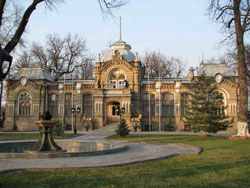
Today, this building serves as the Reception Hall of the Ministry of Foreign Affairs. Its rooms are decorated by local folk artists, yet the building’s distinctly European style has been preserved. It is a characteristic example of Art Nouveau, a style that was very popular at the turn of the 19th and 20th centuries. Architect Wilhelm Geintzelman gave the building a whimsical appearance, designing unusually shaped windows, grilles, turrets, and columns, along with life-size sculptures of dogs and deer.
During Soviet rule, the palace of Prince Romanov in Tashkent was nationalized. The prince himself died in 1918—according to one version, from sudden pneumonia, and according to another, from Bolshevik gunfire. That same year, the palace was repurposed to house an art museum. Later, when the museum was moved to another part of Tashkent, the Romanov palace became the venue for international receptions held by the Uzbek Ministry of Foreign Affairs.
Tashkent Attractions
- Alisher Navoi Grand Opera and Ballet Theater
- Palace of Prince Romanov
- Abulkosim Sheikh Madrasah
- Kukeldash Madrasah
- Juma Mosque
- Courage Monument
- Museum of Applied Art of Uzbekistan
- Alisher Navoi Monument
- Amir Timur Square
- Bunyodkor Square - Friendship of Peoples
- Independence Square
- Chorsu Bazaar
- Tashkent TV Tower
- Shahidlar Khotirasi — in Memory of the Victims of Repressions