Juma Mosque
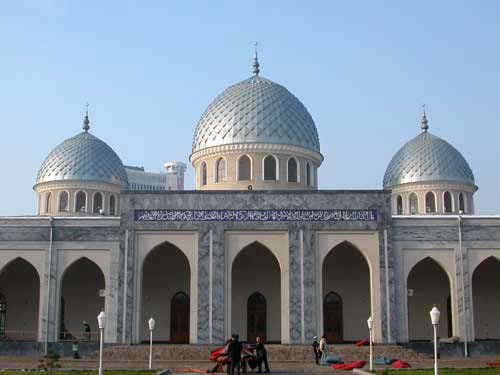
Another name for the building is the Juma Mosque, or Friday Mosque. It is an architectural monument dating back to the 14th–15th centuries and is the third-largest mosque in Uzbekistan, after the Bibi-Khanum Mosque in Samarkand and the Kalyan Mosque in Bukhara. The Juma Mosque is also the only example of a courtyard-style mosque in the capital.
The first structure of the Tashkent Juma Mosque (Main Friday Mosque) was built in 1451 with funds provided by Sheikh Ubaidullah Khoja Akhor (1404–1490).
Sheikh Ubaidullah Khoja Akhror was born in the village of Bogiston, near what is now the Charvak Reservoir. He was a great master of Sufism, a leader of the Muslim clergy, and a descendant of the Prophet Muhammad. One of the Sufi saints, Sheikh Affendi at-Tahr (Sheikhantaur), was his relative on his mother’s side. While still very young, Ubaidullah Akhror became the head of the Sufi order founded by the followers of Bahauddin Naqshbandi. He made significant contributions to the philosophical and legal teachings of the order and, by the mid-15th century, became the leader of the Muslim clergy throughout the state inherited from Tamerlane.
Ubaidullah Khoja Akhror eventually had to leave Tashkent, as Samarkand was the center of religious life at that time. Before his departure, he decided to build a mosque and a madrasah as a gift to the people of Tashkent.
In 1868, the mosque was destroyed by a powerful earthquake, but it was rebuilt in 1888 with funds provided by Russian Tsar Alexander III. After that, it became known as the Tsar’s Mosque. In 1997, the old structure was demolished, and a new mosque—the Jami Mosque—was built in its place. Only the ancient layout and a few fragments of the original structures remain.
Tashkent Attractions
- Alisher Navoi Grand Opera and Ballet Theater
- Palace of Prince Romanov
- Abulkosim Sheikh Madrasah
- Kukeldash Madrasah
- Juma Mosque
- Courage Monument
- Museum of Applied Art of Uzbekistan
- Alisher Navoi Monument
- Amir Timur Square
- Bunyodkor Square - Friendship of Peoples
- Independence Square
- Chorsu Bazaar
- Tashkent TV Tower
- Shahidlar Khotirasi — in Memory of the Victims of Repressions